
Introduction
In today’s competitive digital world, every business wants to appear on the first page of Google when potential customers search for products or services. Having a strong online presence is essential for attracting customers, generating leads and increasing business revenue. However, one common question many business owners ask is: Should they invest in Google Ads or focus on Search Engine Optimisation (SEO)?
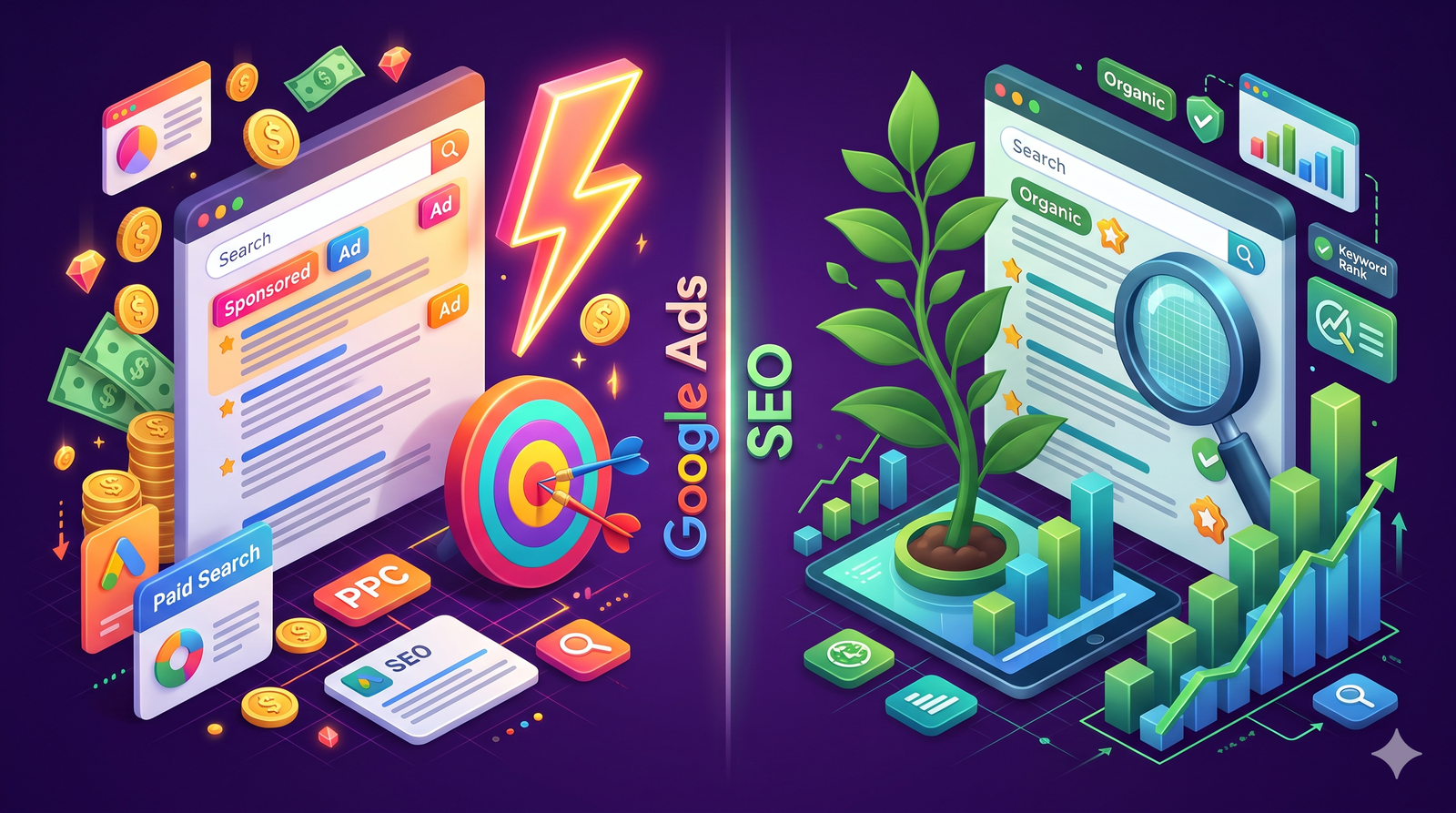
Both Google Ads and SEO are powerful digital marketing strategies that help businesses reach their target audiences through search engines. However, they work in different ways. Google Ads allows businesses to display paid advertisements on Google search results and other advertising networks, while SEO focuses on improving a website’s organic ranking through content optimisation, technical improvements and quality backlinks.
Understanding SEO vs Google Ads is important because choosing the right marketing strategy can influence your advertising budget, website traffic and overall business growth.
For businesses looking for faster visibility, Google Ads Services can provide immediate opportunities to reach potential customers. On the other hand, SEO helps businesses build long-term organic visibility and establish credibility.
In this article, we will explore the major differences between Google Ads and SEO, including their costs, advantages, disadvantages, results and the best situations for using each strategy.
1. What Is Google Ads?
Google Ads is an online advertising platform developed by Google that allows businesses to promote their products and services through paid advertisements.
When users search for specific products or services on Google, relevant paid advertisements may appear at the top or bottom of the search results page. These advertisements are generally marked as sponsored or sponsored results.
Businesses create advertising campaigns by selecting relevant keywords, defining their target audience, setting budgets and creating attractive advertisements.
For example, if someone searches for “best digital marketing agency near me”, businesses running relevant Google Ads campaigns may appear in the sponsored search results.
Google Ads generally operates through a pay-per-click (PPC) model. This means advertisers commonly pay when someone clicks on their advertisement, although other bidding strategies and charging models are also available.
How Google Ads Works
Google Ads uses an advertising auction system to determine which advertisements appear for a particular search.
The process generally includes:
- Keyword Selection: Businesses select keywords related to their products and services.
- Campaign Creation: Advertisers create campaigns with relevant headlines, descriptions and landing pages.
- Budget Setting: Businesses decide how much they want to spend on advertising.
- Audience Targeting: Advertisers select relevant locations, languages, devices and other targeting options.
- Ad Auction: Google evaluates eligible advertisements using factors such as bids, ad quality and expected impact.
- Performance Tracking: Businesses monitor clicks, impressions, conversions and advertising costs.
With professional Google Ads Services, businesses can create properly structured campaigns, reach potential customers and monitor their advertising performance.
2. What Is SEO?
SEO stands for Search Engine Optimisation. It is the process of improving a website’s visibility in organic (unpaid) search engine results.
When people search for information, products or services on Google, search engines analyse different factors to display relevant and useful web pages.
SEO helps businesses improve their chances of appearing in these organic results.
Unlike Google Ads, SEO does not require businesses to pay Google for every organic click. However, SEO requires investment in content creation, website optimisation, technical improvements and other marketing activities.
For example, a digital marketing agency can publish informative blogs about SEO services, website development and online marketing. By optimising these pages for relevant search terms, the business can attract people who are actively looking for digital marketing information and services.
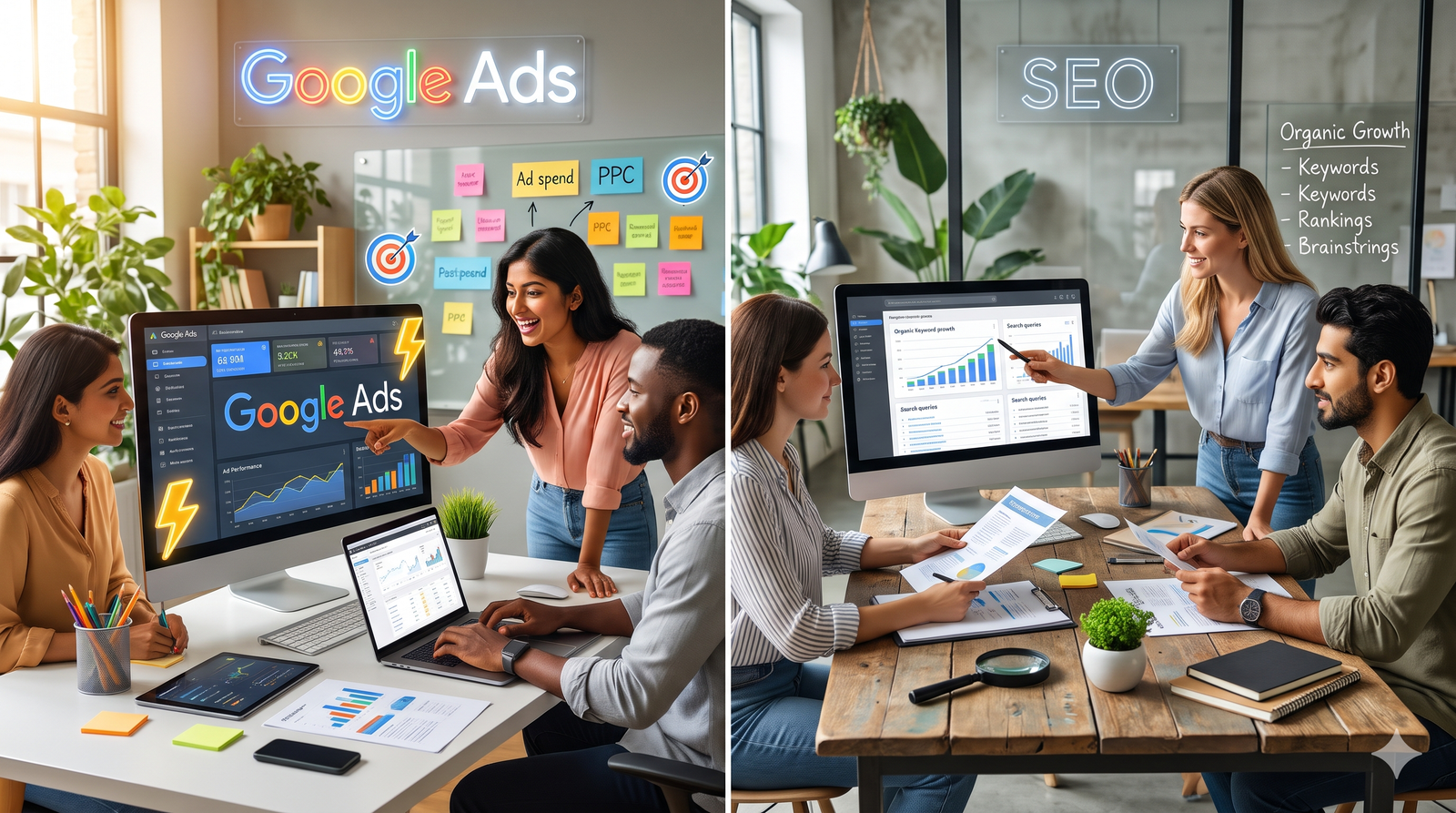
SEO Title Google Ads Services vs SEO: 10 Key Differences for Business Growth
Focus Keyword 1 Google Ads Services
Focus Keyword 2 SEO vs Google Ads
Permalink google-ads-services-vs-seo
Meta Description Explore Google Ads Services and SEO vs Google Ads to understand their costs, benefits and results. Discover the best digital marketing strategy for business growth.
Category Digital Marketing
Image Alt Text Google Ads Services vs SEO comparison for business growth
Image Caption
Main Types of SEO
1. On-Page SEO
On-page SEO focuses on improving individual web pages through keyword placement, headings, meta descriptions, internal links, image optimisation and quality content.
2. Off-Page SEO
Off-page SEO involves activities outside your website that can improve its authority and reputation. Examples include earning relevant backlinks, digital PR and brand mentions.
3. Technical SEO
Technical SEO focuses on improving the technical performance of a website, including website speed, mobile friendliness, indexing, crawlability and site structure.
4. Local SEO
Local SEO helps businesses improve their visibility in location-based searches. It is particularly useful for restaurants, shops, service providers and businesses targeting customers in specific areas.
A well-planned SEO strategy can help businesses attract relevant visitors, improve online credibility and build sustainable organic traffic.
3. SEO vs Google Ads: Key Differences
Although both strategies help businesses appear on Google, they have different approaches, costs and results.
Let’s understand the major differences.
A. Paid Advertising vs Organic Rankings
The biggest difference between SEO and Google Ads is how businesses appear in search results.
Google Ads provides paid placement opportunities. Businesses pay to participate in advertising auctions and display advertisements for relevant searches.
SEO focuses on improving organic rankings through website quality, relevant content, technical optimisation and other search engine ranking factors.
For example, when someone searches for “SEO services”, they may see sponsored Google Ads results followed by organic website listings.
Google Ads can help businesses gain paid visibility, while SEO helps them earn organic visibility.
B. Cost Differences
Cost is one of the most important factors when choosing between Google Ads and SEO.
Google Ads Costs
Google Ads generally follows a bidding system. Advertisers decide how much they are willing to pay for clicks or other advertising outcomes.
The total cost depends on:
- Keyword competition.
- Industry and business category.
- Target location.
- Advertising budget.
- Quality of advertisements.
- Landing page experience.
- Campaign bidding strategy.
For example, keywords related to insurance, finance and legal services may have higher advertising competition than less competitive search terms.
Businesses should monitor their advertising costs regularly to ensure that campaigns generate valuable leads and conversions.
SEO Costs
SEO usually requires investment in activities such as:
- Website optimisation.
- Content writing.
- Keyword research.
- Technical SEO.
- Link building.
- Competitor analysis.
- SEO monitoring and reporting.
SEO does not involve paying Google for individual organic clicks. However, businesses may need to pay SEO professionals or agencies to manage and improve their websites.
The investment depends on website size, competition, industry and the amount of work required.
C. Time Required to See Results
Google Ads and SEO also differ in the time required to generate visibility.
Google Ads: Once a campaign is properly configured, approved and eligible, advertisements can start appearing relatively quickly. This makes Google Ads useful for businesses that want immediate promotional visibility.
SEO: SEO generally requires more time because search engines need to crawl, index and evaluate website content. Improvements may take several weeks or months, depending on competition, website quality and the strategy used.
Therefore, businesses looking for faster visibility may prefer Google Ads, while those interested in building long-term organic traffic should invest in SEO.
D. Traffic Generation
Google Ads generates paid traffic through advertisements. Businesses can target relevant searches and direct users to specific landing pages.
SEO generates organic traffic when users discover a website through unpaid search results.
Both approaches can attract potential customers, but the quality of traffic depends on keyword selection, search intent, advertisement relevance and landing page quality.
E. Long-Term Benefits
Google Ads generally provides visibility while campaigns are active and eligible to serve. When advertising stops, the paid traffic generated by those campaigns usually decreases.
SEO can provide longer-lasting benefits because well-optimised content may continue attracting visitors even without continuous advertising expenditure.
However, organic rankings are not permanent. They can change due to competitors, search engine updates, changing search behaviour and content quality.
This makes regular SEO maintenance important.
4. Benefits of Google Ads for Business Growth
Google Ads is an effective marketing solution for businesses that want to promote products and services to people actively searching for relevant information.
Here are some important benefits.
1. Immediate Advertising Visibility
One major advantage of Google Ads is the ability to gain visibility relatively quickly after launching an eligible campaign.
Businesses do not have to wait for organic rankings to improve before appearing in paid search placements.
2. Targeted Advertising
Google Ads provides different targeting options that help businesses reach relevant audiences based on factors such as location, language, keywords and other available audience signals.
For example, a business operating in Visakhapatnam can target relevant customers in that area rather than advertising across the entire country.
3. Budget Flexibility
Businesses can set campaign budgets and adjust their spending according to marketing requirements.
This allows small businesses to begin with controlled advertising budgets and increase investment when campaigns perform well.
4. Measurable Campaign Performance
Google Ads provides performance information such as impressions, clicks, click-through rates, conversions and advertising costs.
These metrics help businesses understand how their campaigns are performing.
5. Promotes Specific Products and Services
Businesses can create separate campaigns for individual products, services, seasonal offers and promotional activities.
For example, a digital marketing agency can create dedicated campaigns for SEO, website development and social media marketing.
6. Supports Lead Generation
Google Ads can help businesses attract potential customers through enquiry forms, phone calls, website visits and other conversion actions.
With proper campaign management, businesses can improve the relevance of their advertisements and generate valuable enquiries.
5. Benefits of SEO for Business Growth
SEO is an important long-term digital marketing strategy that helps businesses improve their organic search visibility.
Here are its major benefits.
1. Builds Organic Website Traffic
SEO helps websites attract visitors through unpaid search results.
When web pages rank for relevant keywords, people searching for those topics can discover the business naturally.
2. Improves Brand Credibility
Websites that provide useful information and appear prominently in organic search results can build trust with potential customers.
Consistent content quality and a positive website experience also contribute to brand credibility.
3. Provides Long-Term Value
Unlike paid advertisements, SEO content can continue attracting organic visitors after it has been published and optimised.
Although regular maintenance is necessary, high-quality content can provide ongoing value.
4. Improves User Experience
SEO involves improving several aspects of a website, including navigation, mobile usability, page speed and content structure.
These improvements make it easier for visitors to find information and interact with the website.
5. Supports Local Business Growth
Local SEO helps businesses appear in relevant location-based searches.
For example, a website optimised for digital marketing services in Visakhapatnam may attract potential customers searching for marketing agencies in that location.
6. Reduces Dependence on Paid Traffic
A strong organic search presence gives businesses another source of website traffic.
This can reduce their dependence on paid advertising over time, although it does not eliminate all marketing expenses.
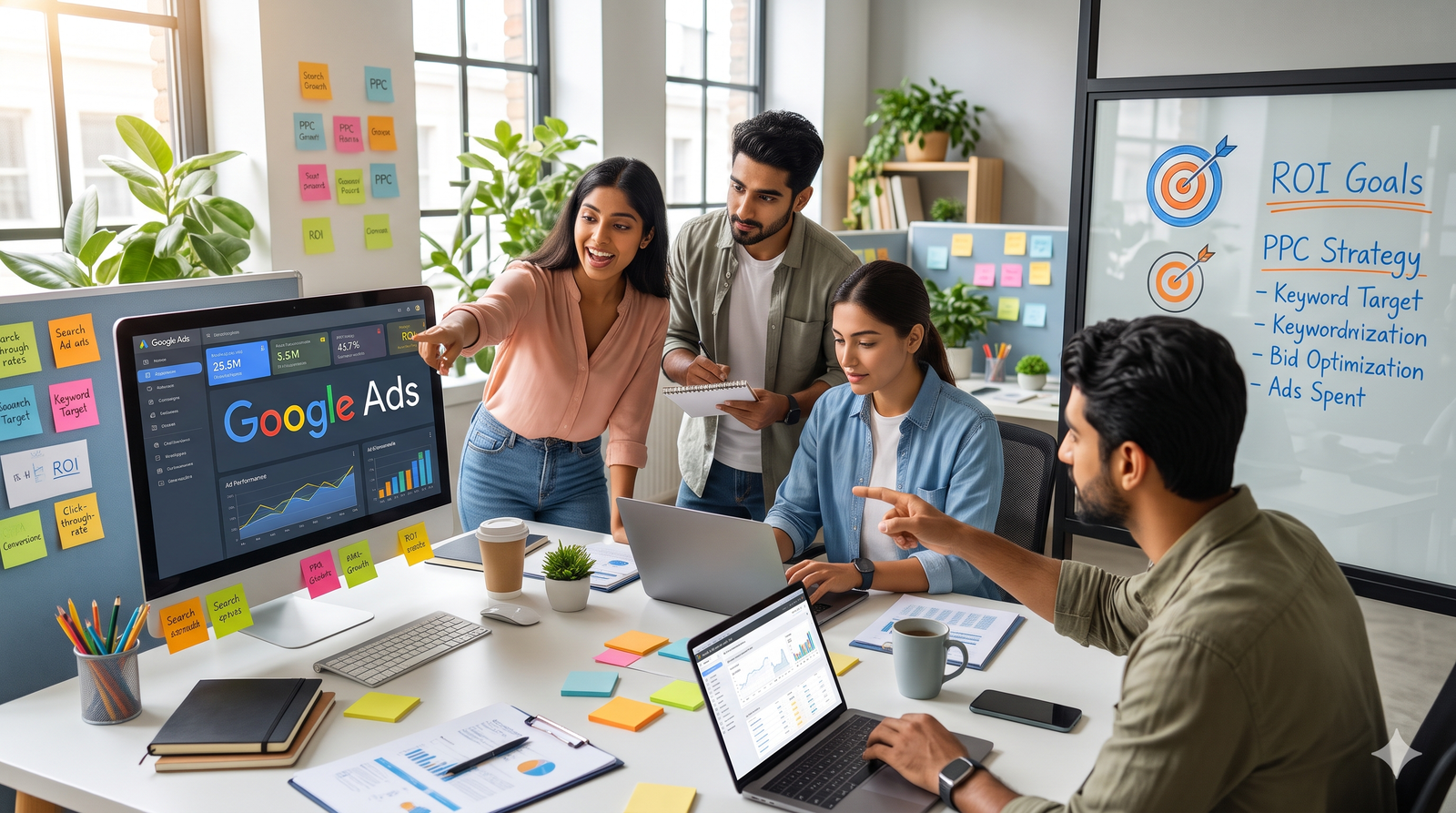
6. Disadvantages of Google Ads and SEO
Both marketing strategies have advantages, but businesses should also understand their limitations.
Disadvantages of Google Ads
- Advertising requires continuous investment.
- Highly competitive keywords can be expensive.
- Poorly managed campaigns may waste advertising budgets.
- Advertisements stop generating paid visibility when campaigns are paused or become ineligible.
- Some users prefer clicking on organic results rather than advertisements.
- Effective campaigns require regular monitoring and optimisation.
Disadvantages of SEO
- SEO generally takes time to show meaningful results.
- Organic rankings are not guaranteed.
- Search engine algorithm updates can affect rankings.
- Competitive industries require consistent effort.
- Quality content and technical improvements require investment.
- SEO needs regular monitoring and maintenance.
Understanding these limitations helps businesses select a marketing strategy that matches their objectives and available resources.
7. Google Ads vs SEO: Which Is Better for Small Businesses?
Small businesses often have limited marketing budgets and need to select strategies carefully.
The right choice depends on the business type, target audience, competition and marketing goals.
Choose Google Ads if:
- You want to promote a new product or service quickly.
- You need enquiries within a shorter period.
- You are running a seasonal promotion.
- You want to target customers in a particular location.
- You have a defined advertising budget.
Choose SEO if:
- You want to build long-term organic traffic.
- You want to improve your website’s search visibility.
- You regularly publish informative content.
- You want to establish authority in your industry.
- You want to attract customers through organic search.
For example, a newly launched online store may use Google Ads to promote its products immediately while investing in SEO to build organic traffic over time.
This approach allows businesses to work towards short-term marketing objectives and long-term growth simultaneously.
8. Why Combining Google Ads and SEO Can Be More Effective
One of the most effective digital marketing approaches is combining Google Ads and SEO rather than depending entirely on one strategy.
Both methods support different aspects of online marketing.
Google Ads can provide faster paid visibility, while SEO helps build a sustainable organic presence.
Using both strategies can offer several advantages:
Better Search Visibility: Your business may gain opportunities to appear in both paid and organic search results for relevant searches.
Keyword Research Opportunities: Google Ads campaign data can help identify keywords that attract clicks and conversions. These insights may support SEO planning.
Improved Landing Pages: Both strategies benefit from relevant, useful and well-structured landing pages.
Audience Understanding: Advertising performance and organic search data can provide insights into customer interests and search behaviour.
Balanced Marketing Strategy: Businesses can use paid campaigns for immediate opportunities while developing organic rankings for long-term value.
For example, a company offering website development can use Google Ads to attract immediate enquiries while publishing SEO-focused blogs about website design, development costs and website maintenance.
Over time, this combined strategy can support a stronger online presence.

9. How Kareer9 Helps Businesses with Google Ads and SEO
At Kareer9, we understand that every business needs a suitable digital marketing strategy to compete in the online marketplace.
Our aim is to help businesses strengthen their digital presence, reach potential customers and improve their online visibility through effective marketing solutions.
We understand that selecting between paid advertising and organic search optimisation can be challenging. That is why choosing the right approach based on your business goals is important.
Our digital marketing solutions include:
Google Ads Services: We help businesses plan advertising campaigns, identify relevant keywords, create advertisements and monitor campaign performance.
SEO Services: We focus on keyword research, on-page optimisation, technical improvements, content optimisation and other SEO activities to support organic visibility.
Keyword Research: Identifying relevant search terms helps businesses understand what potential customers are looking for.
Landing Page Optimisation: Relevant and informative landing pages help visitors understand products and services and encourage meaningful actions.
Performance Monitoring: Analysing campaign data helps businesses identify opportunities for improvement.
Digital Marketing Strategy: We aim to develop suitable strategies based on business objectives, audience requirements and available budgets.
Whether you are a startup, small business or established company, Kareer9 aims to support your digital marketing journey through suitable online marketing solutions.
10. Future of SEO and Google Ads in Digital Marketing
The digital marketing industry continues to evolve as search technologies, artificial intelligence and customer behaviour change.
Search engines are becoming more advanced in understanding user intent and delivering relevant information.
Businesses must therefore focus on providing useful content, improving website experiences and creating relevant advertising campaigns.
Some important developments influencing the future of digital marketing include:
- Artificial intelligence in advertising optimisation.
- AI-assisted content creation and analysis.
- More personalised advertising experiences.
- Voice and conversational search.
- Improved conversion tracking.
- Mobile-first website experiences.
- Changing search result layouts.
- Greater emphasis on helpful and trustworthy content.
Businesses that regularly adapt their strategies can discover new opportunities to reach their target audiences.
Rather than focusing only on rankings or clicks, companies should concentrate on meaningful outcomes such as qualified leads, customer satisfaction and business growth.
Conclusion
When comparing SEO vs Google Ads, there is no single strategy that is perfect for every business. Both offer different advantages depending on marketing goals, budget and business requirements.
Google Ads is suitable for businesses looking for faster paid visibility, targeted advertising and immediate promotional opportunities. SEO is more suitable for businesses interested in building organic traffic, improving website credibility and developing long-term search visibility.
For the best results, businesses can combine both strategies to create a balanced digital marketing approach.
Investing in professional Google Ads Services and effective SEO can help businesses reach potential customers, improve their online presence and work towards sustainable growth.
At KCareer9, we believe that the right digital marketing strategy can make a meaningful difference to business success.
Want to grow your business online? Connect with KCareer9 today and explore the right Google Ads and SEO solutions for your business.